PROBLEM SPACE
Historically, people living in the United States have a distrust of institutions. Gallup reports that in the last three years, trust in institutions have hit an all time low.
In recent years, there has been a growing disconnect between people and their local governments. People often feel unheard and disregarded in the planning process for their communities’ futures. This has sown distrust and frustration into the relationship between people and their groups of local officials.
EXPLORATORY RESEARCH
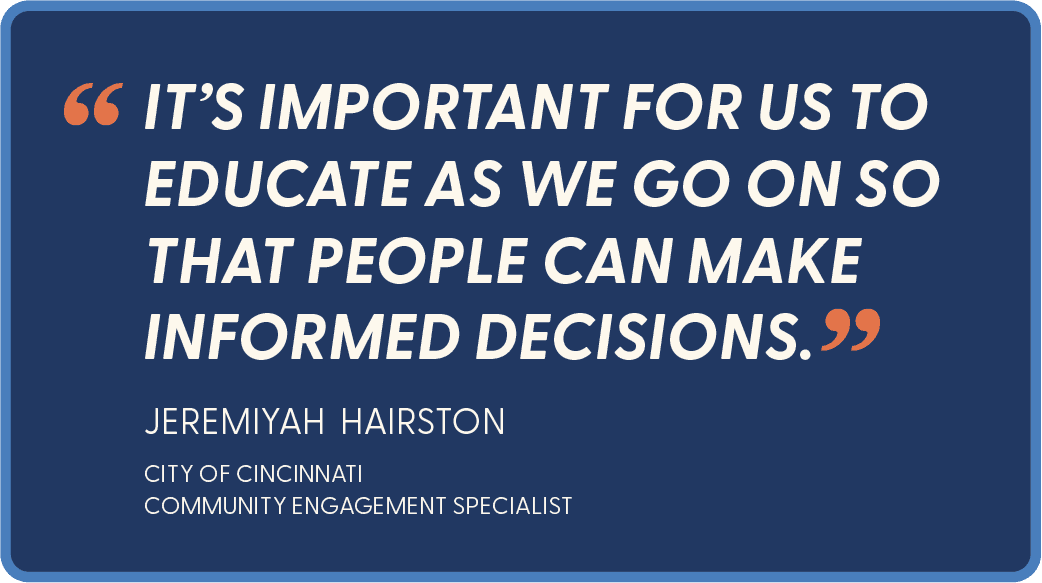
We conducted an expert interview with two Community Engagement Specialists and two City Planners who work for the City of Cincinnati. Experts agreed that both sides of the process need to understand the other party’s point of view, so a form of two-way communication would be most productive.
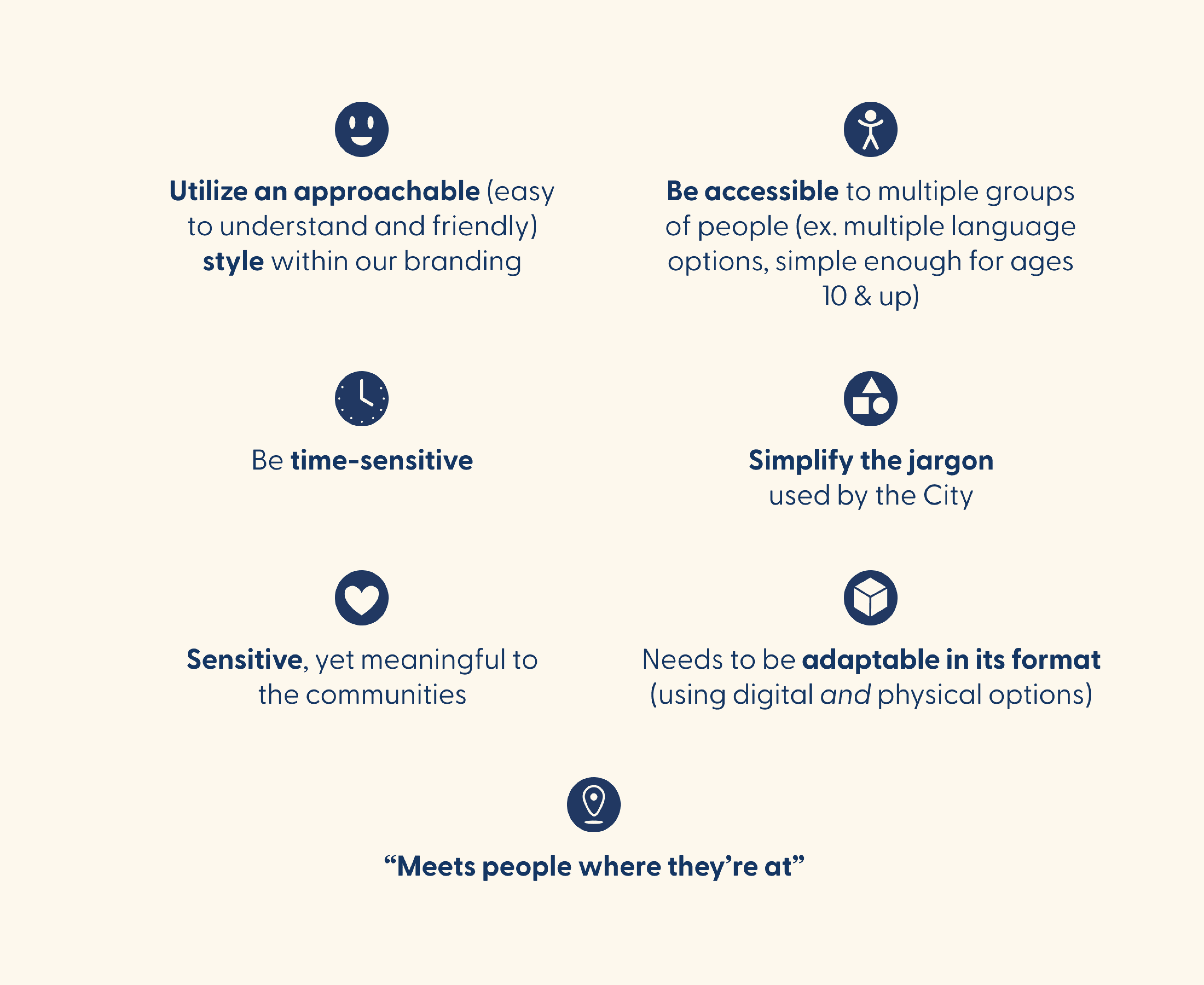
Moving forward, we wanted our brand to be accessible to multiple groups of people of all ages and backgrounds, sensitive and meaningful to communities, and “meet people where they are at”.
GENERATIVE RESEARCH
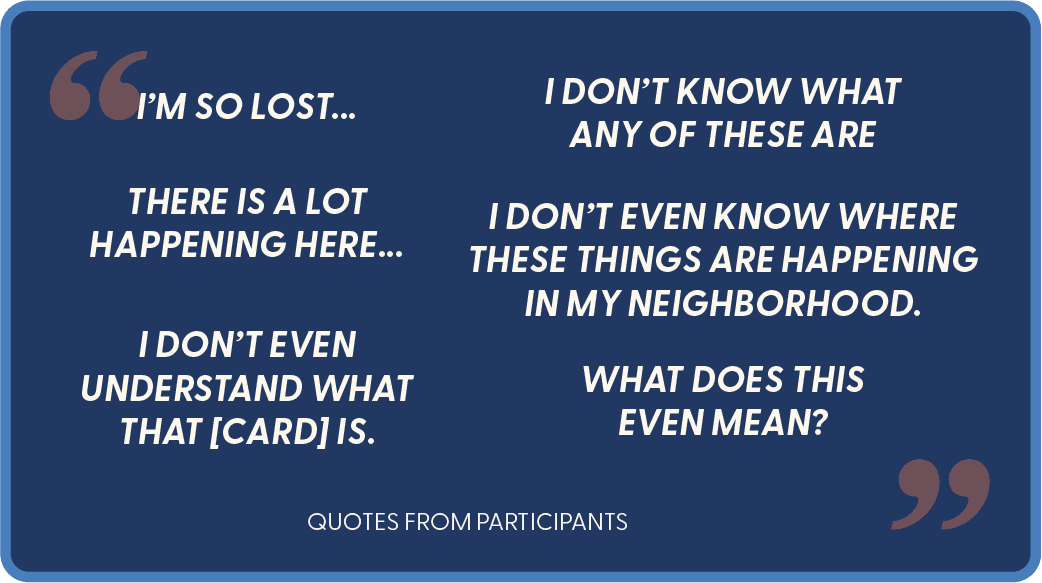
In our research, participants were consistently confused by the language used by the City in current materials. They felt the time needed to spend on participating in meetings was inconvenient. Locals expressed concerns about their community lacking access to technology and digital formats of education.
Our next steps included simplifying jargon and language used by the City, being time-sensitive for those who are busy, and being adaptable in format for communities that cannot conveniently access or afford technologies.
EVALUATIVE RESEARCH
We developed a brand that felt friendly, less institutional, and clear. Our team developed a video and poster series that allow viewers to better grasp how the process of rezoning works and how it impacts them as individuals, as well as their neighborhood.
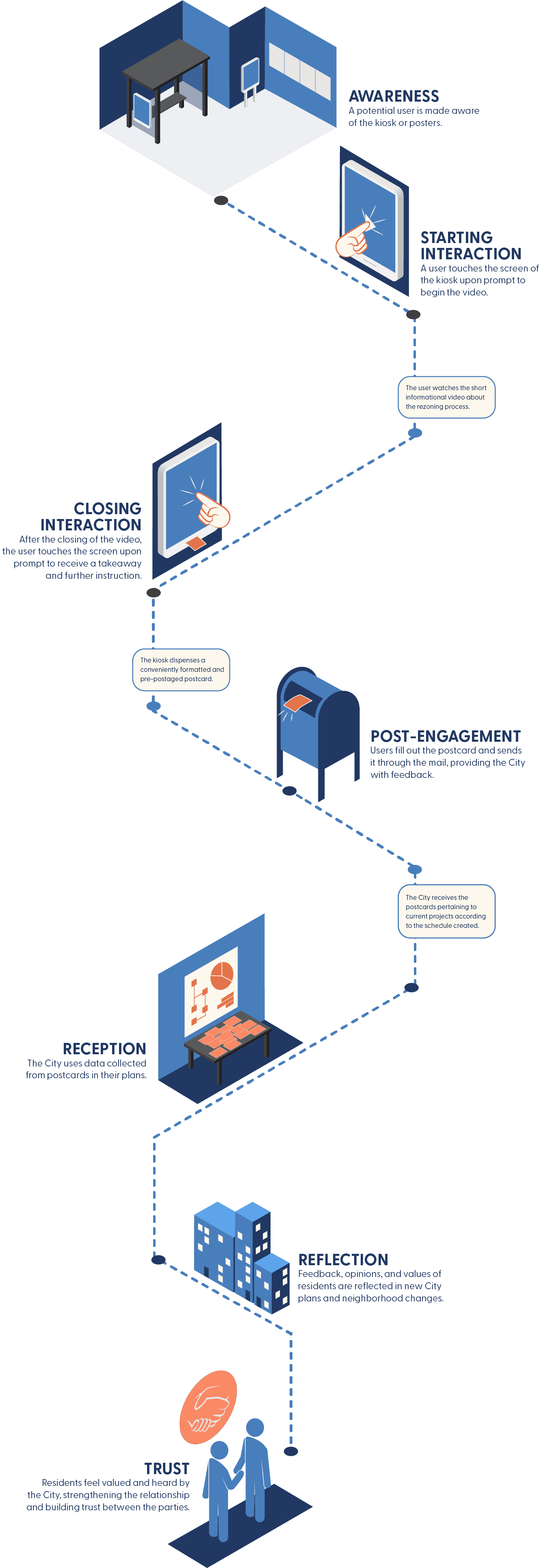
The interactive video kiosk lives near sites that may be rezoned, allowing users to request a card that is pre-postaged to provide the City with prompt feedback so that officials might have a better understanding of what their constituents want for the future of their area.
Challenges &
Design Criteria
Our team walked away from each stage of our research with a new list of design criteria to consider as we iterated. It was important that we listened to both sides of this process to create a system that would not only connect with our audience, but also be easy to understand and applicable to the wide range of neighborhoods in Cincinnati.
PROBLEM STATEMENT
How might we better educate people in local communities on the processes of city planning and how to be involved in them to promote trust, transparency, and a stronger relationship between the City and its residents?
PROBLEM STATEMENT
How might we better educate people in local communities on the processes of city planning and how to be involved in them to promote trust, transparency, and a stronger relationship between the City and its residents?
PROJECT DEFINITION
This informative pilot campaign involving a new brand identity applied to an animated video and poster series will educate East Price Hill and University of Cincinnati members on the process of rezoning and civic engagement.
PROJECT DEFINITION
This informative pilot campaign involving a new brand identity applied to an animated video and poster series will educate East Price Hill and University of Cincinnati members on the process of rezoning and civic engagement.
TOUCHPOINTS
Animated Poster Series
In our research, video and motion graphics were more interesting to viewers and the quickest way to convey information. This poster focused on the city process of Rezoning, which directly affects community members.
Other animated posters would discuss processes like "The Sale or Lease of City-Owned Property", "Designation of a Historic District or Landmark", and "Acquisition of Financial Assistance with Development".
Postcards
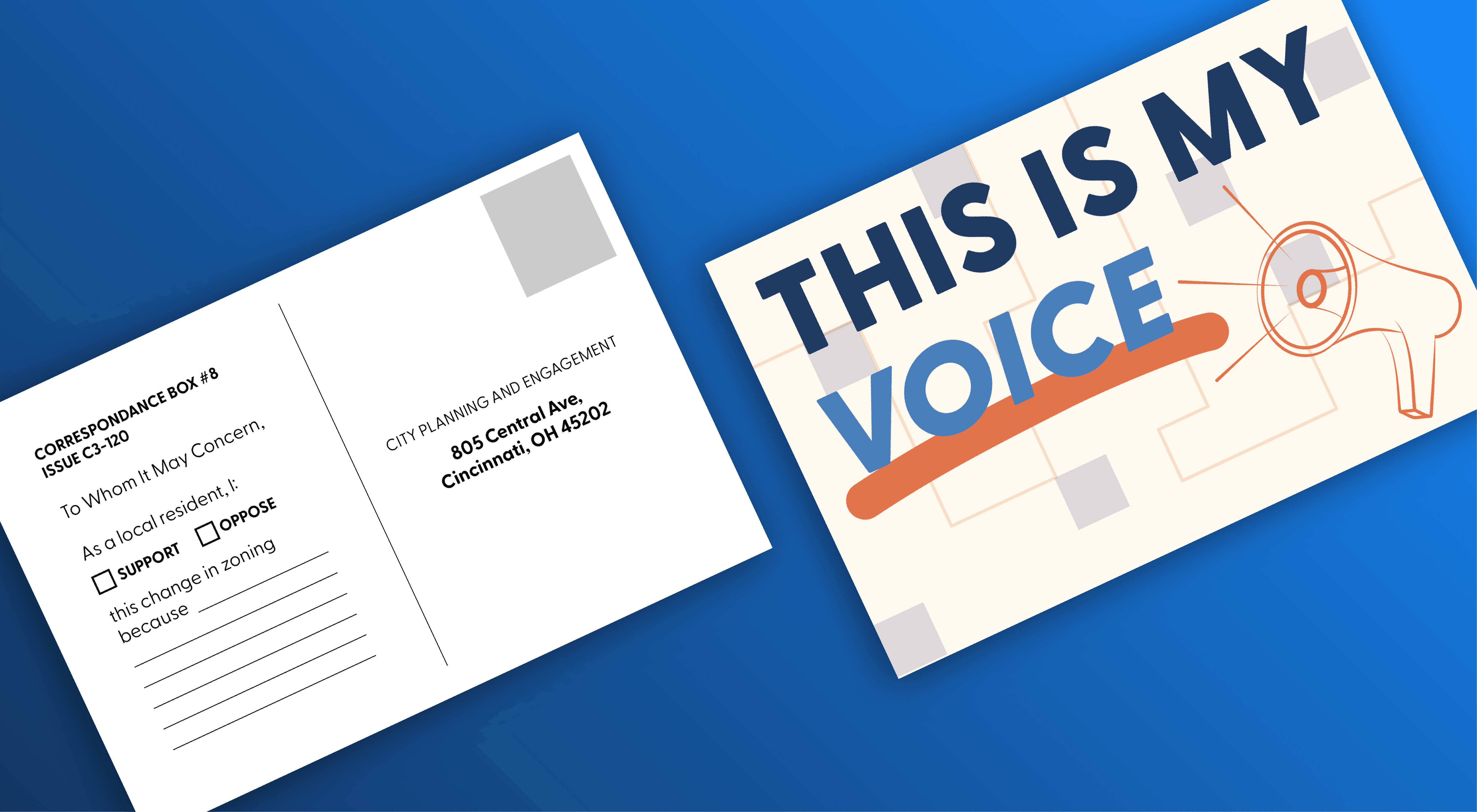
These postcards would follow a system of labels that denote the area or neighborhood of Cincinnati in which they were obtained, as well as the issue or topic displayed at the kiosk from which they were obtained.
Community members can quickly fill out these postcards and return them to the City as they are pre-labeled and postaged for their convenience.
Static Poster Series
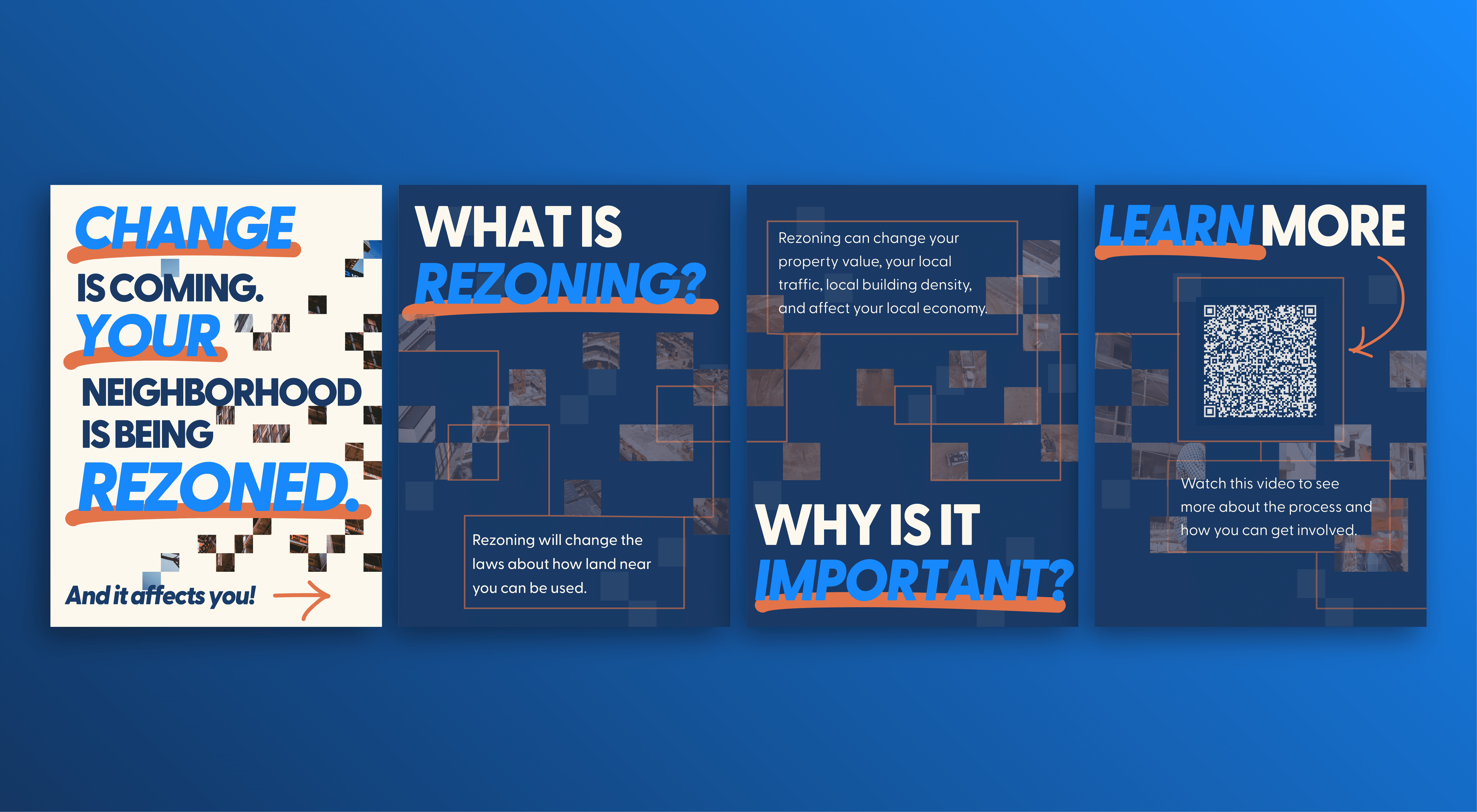
For neighborhoods that lack the space, funding, or other resources for animated posters, we created a static series that introduced why the rezoning process is important and how it affects community members. Relating content back to the viewer was the most successful pathway we found to getting residents to interact with the static posters. The QR code links back to touchpoint A for community members to save or watch on-the-go.
SYSTEM DESIGN
Animated Poster Series
In our research, video and motion graphics were more interesting to viewers and the quickest way to convey information. This poster focused on the city process of Rezoning, which directly affects community members.
Other animated posters would discuss processes like "The Sale or Lease of City-Owned Property", "Designation of a Historic District or Landmark", and "Acquisition of Financial Assistance with Development".
Static Poster Series
For neighborhoods that lack the space, funding, or other resources for animated posters, we created a static series that introduced why the rezoning process is important and how it affects community members. Relating content back to the viewer was the most successful pathway we found to getting residents to interact with the static posters. The QR code links back to touchpoint A for community members to save or watch on-the-go.
Postcards
These postcards would follow a system of labels that denote the area or neighborhood of Cincinnati in which they were obtained, as well as the issue or topic displayed at the kiosk from which they were obtained.
Community members can quickly fill out these postcards and return them to the City as they are pre-labeled and postaged for their convenience.
Static Poster Series
For neighborhoods that lack the space, funding, or other resources for animated posters, we created a static series that introduced why the rezoning process is important and how it affects community members. Relating content back to the viewer was the most successful pathway we found to getting residents to interact with the static posters. The QR code links back to touchpoint A for community members to save or watch on-the-go.
Postcards
These postcards would follow a system of labels that denote the area or neighborhood of Cincinnati in which they were obtained, as well as the issue or topic displayed at the kiosk from which they were obtained.
Community members can quickly fill out these postcards and return them to the City as they are pre-labeled and postaged for their convenience.
SYSTEM DESIGN
PROBLEM STATEMENT
How might we better educate people in local communities on the processes of city planning and how to be involved in them to promote trust, transparency, and a stronger relationship between the City and its residents?
PROJECT DEFINITION
This informative pilot campaign involving a new brand identity applied to an animated video and poster series will educate East Price Hill and University of Cincinnati members on the process of rezoning and civic engagement.